
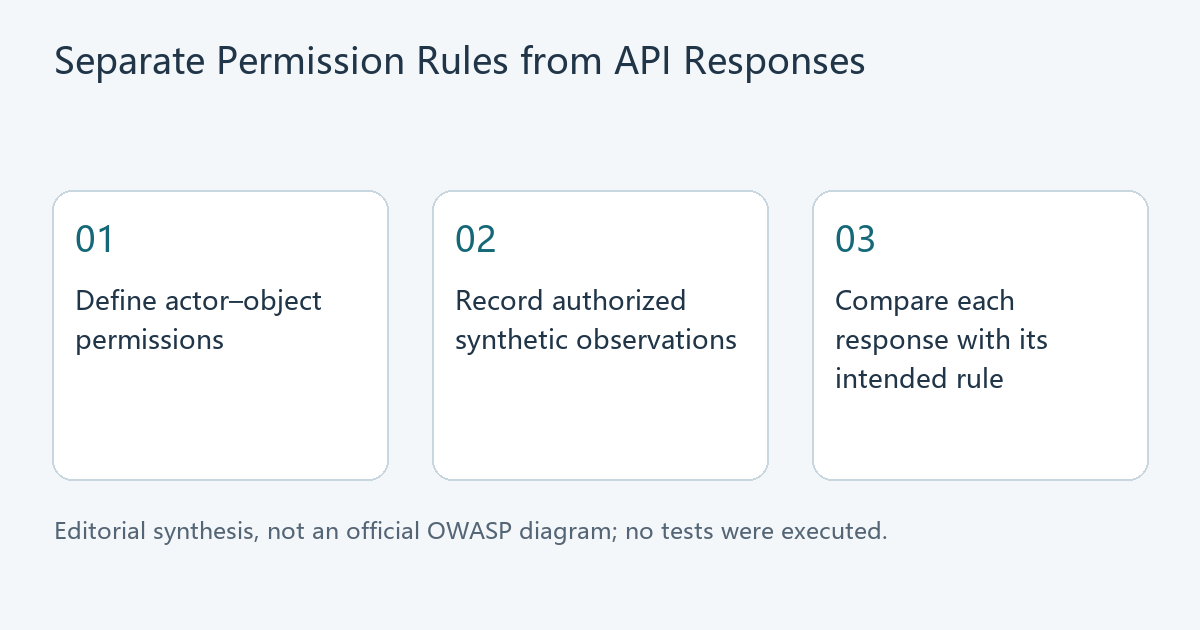
An unpredictable object ID does not establish permission to access that object. For an AI integration review, write down who should access which object before interpreting any response. A successful request demonstrates behavior; deciding whether that behavior was authorized requires a separate permission rule.
This article provides an editorial review method, not executed test results. Any proposed checks belong only in an owned or explicitly authorized environment using synthetic accounts and data.
What the captured OWASP explanation establishes
The captured OWASP API1:2023 explanation of broken object-level authorization describes object-ID manipulation and explicitly includes sequential integers, UUIDs, and strings. IDs may appear in paths, query parameters, headers, or request payloads. Identifier format therefore does not settle the authorization question.
OWASP says responses usually reveal whether a request succeeded. It also describes possible consequences of unauthorized object access: disclosure, data loss, manipulation, and, under some circumstances, account takeover. These are documented possibilities, not findings about your integration.
A hypothetical two-user review matrix
Assumptions for this example: synthetic account A owns object X; synthetic account B owns object Y. The agreed policy permits each account to read only its own object. There is no sharing, delegation, or administrator exception. Use fixture IDs already known to the authorized reviewer, not guessed identifiers.
Keep the operation identical across all four rows: read one synthetic object. Establish the intended rule independently of the response. Every observation below remains unfilled because no requests were executed.
| Acting account | Requested object | Intended permission | Observed response |
|---|---|---|---|
| A | X, owned by A | Allow read | Not run |
| A | Y, owned by B | Deny read | Not run |
| B | Y, owned by B | Allow read | Not run |
| B | X, owned by A | Deny read | Not run |
This matrix is editorial synthesis, not an OWASP-prescribed procedure. Its purpose is to prevent an observation such as “request succeeded” from silently becoming the permission rule.
Make each observation interpretable
- Identify the acting principal. Record whether the proposed request represents synthetic user A, synthetic user B, or an integration service identity. If the AI tool uses a service identity, do not silently label that request as an end-user request. Document how the intended user restriction is supposed to apply.
- Fix the comparison conditions. Record the operation, environment, policy version, object ownership, and fixture identifier. Use separate synthetic sessions and confirm the intended account before each authorized check. Never put credentials into the review worksheet.
- Record more than a success label. Reserve fields for response status, returned synthetic content, and any relevant authorized server-side evidence. Keep the expected permission and actual observation in different columns.
- Keep the conclusion narrow. A read-only matrix does not evaluate update, delete, export, sharing, or every endpoint. Review additional operations separately if they fall within the approved scope.
Decide what the evidence means
- Expected allow, matching object returned: that row matches the hypothetical policy. It says nothing about the cross-account rows.
- Expected deny, other account's object returned: treat this as a permission mismatch requiring investigation. Stop expanding the check and retain only approved synthetic evidence.
- Expected deny, object withheld: record the observation, but do not declare universal authorization correctness from one denial.
- Wrong account, missing fixture, or ambiguous response: mark the row inconclusive. Correct the setup before interpreting it as a security result.
For an AI integration, the practical deliverable is a permission-and-observation worksheet, not a claim that UUIDs make access safe. Keep the policy decision separate from identifier appearance, request completion, and model-generated explanations.
Evidence date and refresh limits
Source check date: October 22, 2026. This article uses the supplied OWASP capture from 09:57:29 UTC, not a live service or availability check. Its evidence validity ends October 23, 2026, at 09:57:29.509401 UTC. Refresh the source after expiry or changed OWASP guidance; revisit the worksheet whenever identity mapping, ownership, sharing rules, or endpoint behavior changes. No implementation, request, response, or security outcome was tested here.

