
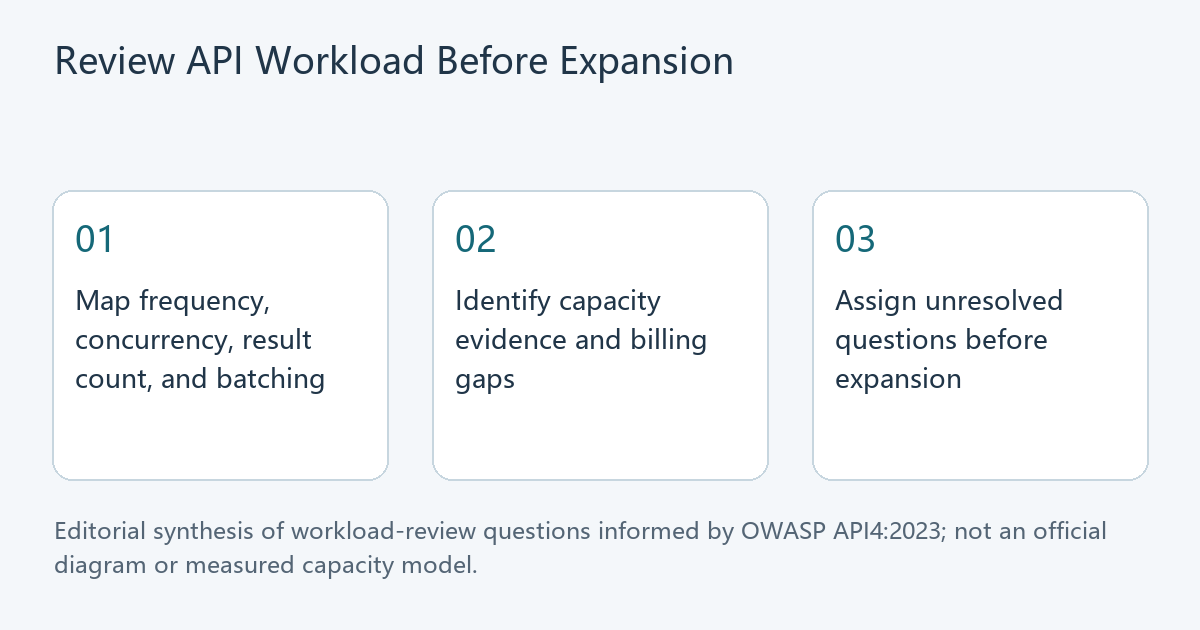
Review the workload, not just an individual request. Before expanding an API automation, document how often it runs, how many requests can overlap, how many results each request asks for, and how many operations each batch contains. Treat missing capacity or billing information as an unresolved review question—not evidence that a small-looking request is harmless.
Official evidence: OWASP API4:2023, Unrestricted Resource Consumption describes concurrent requests, parameters controlling returned resources, and batched operations as relevant to resource exposure. It identifies possible denial of service through resource starvation and increased operational costs, including CPU and storage costs. That establishes a risk category; it does not establish your endpoint’s capacity, prices, or safe workload.
A four-dimension workload review
Editorial checklist: The table below translates that risk category into design-review questions. Its questions are not OWASP-prescribed thresholds, and completing the table does not certify an automation as safe.
| Dimension | Record before expansion | Resource-demand question | Possible failure-impact question |
|---|---|---|---|
| Request frequency | Triggers, schedules, repeat attempts, and who can change them. | Does the workload description include repeated attempts, or only the intended schedule? | If a run fails, will the next run wait, replace it, or add more pending work? |
| Concurrency | Workers and schedules that may overlap, including separate deployments. | Who approves the combined overlap rather than each worker in isolation? | Could several automations encounter the same capacity constraint at once? |
| Requested result count | The requested page or result count and the reason it is needed. | Is the quantity explicit, and what documentation supports the permitted range? | If a response is incomplete, how will downstream work distinguish that from a complete result? |
| Batching | Operations per batch and any documented execution or billing rules. | Are you counting submitted requests, contained operations, or both? | What happens to completed and unfinished operations if only part of a batch succeeds? |
Read across the rows together. An explicit batch size does not answer the overlap question. A documented request frequency does not explain how retries are handled. Keep each unanswered question visible rather than replacing the whole review with a single request-count figure.
Turn the table into a bounded decision
The following is an editorial review method, not a capacity test or a universal operating policy. Use existing configuration, service documentation, and authorized records; do not generate disruptive traffic to fill gaps.
- Describe one complete run. Write down its trigger, workers, requested results, batches, and repeat-attempt behavior. State which entries are configuration facts and which remain assumptions.
- Separate the capacity and cost questions. Ask what evidence supports the proposed workload and what billing terms apply. Do not substitute request counts for a bill estimate without a documented charging model.
- Assign unresolved questions. Identify the person responsible for obtaining each missing answer. If combined overlap or billing treatment is unknown, leave expansion unresolved instead of recording a pass.
- Record the response to trouble. Name who can pause the automation, what happens to pending work, and how partial results will be handled. Choose workload-specific boundaries with the responsible service owner; this article supplies no numeric limits.
Hypothetical example: one request versus one batch
Hypothetical, not a tested workload: Imagine a scheduled automation with three workers, each submitting one batch containing ten operations. A review entry saying “three requests” leaves the contained operations undescribed. An entry saying “thirty operations” still leaves execution timing and billing treatment unanswered. If another scheduled run overlaps, that overlap also needs an explicit entry.
The decision is not to assume a particular cost or failure. It is to ask whether the proposed configuration has adequate workload, execution, and billing documentation before expanding it. These example numbers are bookkeeping aids, not recommended settings or measured capacity.
Evidence boundary and refresh triggers
Source check date in the supplied record: October 22, 2026. The OWASP excerpt was captured at 09:57:29 UTC and expires on October 23 at 09:57:29 UTC. This article interprets that supplied capture; it is not a live availability check or a firsthand test.
Refresh the source after its expiry or if the cited guidance changes. Revisit the workload review when triggers, worker overlap, result counts, batch behavior, retry settings, or pricing terms change. The supplied excerpt cannot settle provider-specific execution rules, actual charges, or whether a particular automation will cause service degradation.

